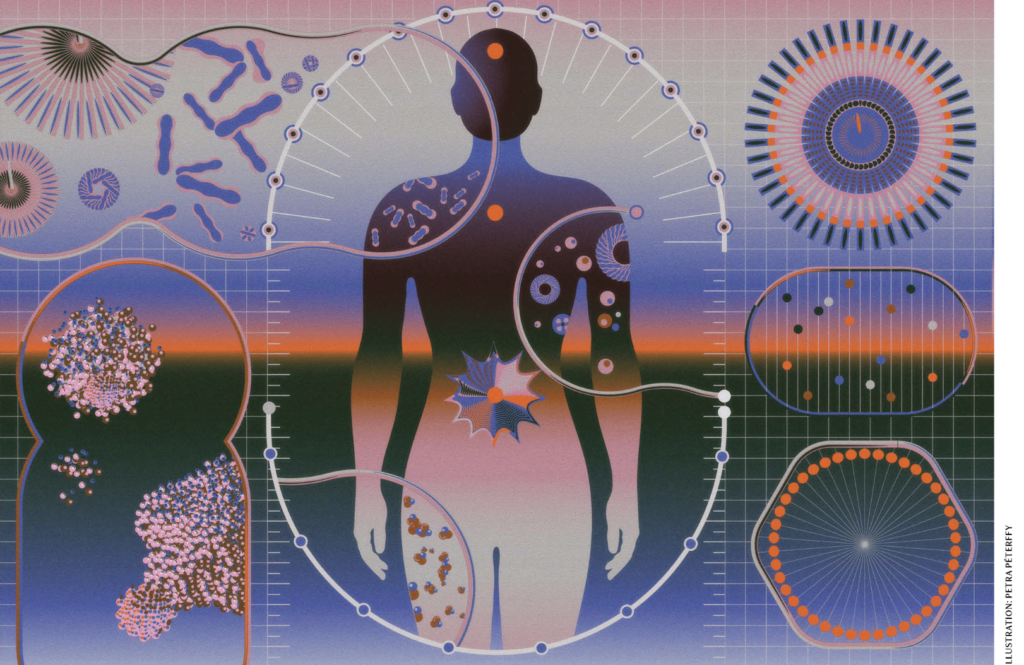
Could measuring immune health reshape medical care?

The immunome can show how well the body defends itself, adapts to challenges, and recovers from stress, a capacity that changes over time. In a new Comment in Nature, HIP Co-Chief Science Officer John Tsang, with Hugo Aerts, Nicolai Birkbak, and Eric Topol, argues that researchers already have the tools to begin measuring it. The work ahead is to identify which measurements matter, validate them across diverse populations, and show when acting on them improves outcomes.

If scientists can work out which measurements matter, validate them across diverse populations and establish when acting on them improves disease outcomes, immune health could become a routine dimension of medicne, considered not only after the immune system has failed, but also as a tool to help preserve health before it does.

Recent Posts

  • 15 challenges at the intersection of biology & AI

    A new Perspective in Cell, co-authored by HIP Co-Chief Science Officer John Tsang alongside leading researchers from Columbia, Stanford, and the Chan Zuckerberg Initiative, tackles one of the biggest open questions in biomedical AI: why hasn’t generative AI’s success in protein folding translated to predicting how cells and tissues actually behave? Drawing inspiration from Hilbert’s landmark... Read More
  • How do you measure an aging immune system? HIP Co-CSOs publish new framework.

    A new Nature Medicine Perspective, “Immune Aging Biomarkers for Clinical Trials,” tackles a question at the heart of HIP’s mission: there’s still no agreed-upon way to measure immune aging. Co-authored by HIP Co-Chief Scientific Officers Shai Shen-Orr and John Tsang, alongside researchers from Stanford, Yale, UConn, University College London, the National Institute on Aging, and others, the... Read More

Responses

Respond

Your email address will not be published. Required fields are marked *